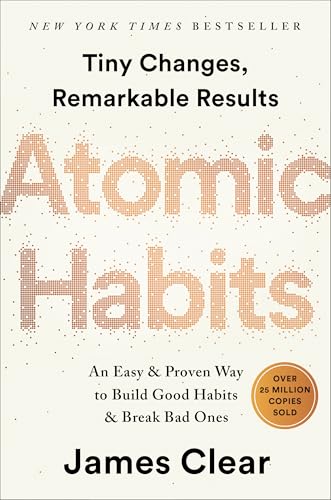
Atomic Habits
MIT habit loop and implementation intentions hold up. 1% calculus is metaphor; environmental claims rest on observation.
Each Law maps to a named intervention: implementation intention, temptation bundling, Two-Minute Rule, streak tracking.
Each behavior as vote for a self-concept is a useful synthesis. Building the identity before it's real is unaddressed.
Core Thesis
"Tiny behavioral adjustments compound over time into extraordinary results through identity-based habits and environmental design. Small changes, repeated consistently, matter far more than motivation or willpower."
Verdict
- Must read for/if: You’re pursuing long-term behavior change — health, productivity, learning, leadership — and want a systems-based approach instead of willpower-dependent motivation. Essential for managers building team habits and for anyone frustrated with the traditional goal-setting paradigm.
- Skip if: You need deep scientific rigor or are already fluent in behavioral psychology. Clear’s framework is practical and accessible, not research-dense. Also diminishing returns if you’ve already read BJ Fogg’s Tiny Habits or Duhigg’s The Power of Habit — the conceptual territory overlaps significantly.
- Core business value: The identity-based habits framework explains why goal-setting alone fails and why environmental design outperforms motivation. In organizations, this translates to: invest in systems and culture rather than expecting individual willpower. The Four Laws give managers a concrete checklist for diagnosing why a desired behavior isn’t sticking and a clear intervention for each failure mode.
- The reviewer’s take: The Four Laws system is the most operationally complete habit formation model in popular business writing, and the identity-based reframe is the most useful single insight in the genre — but Clear synthesizes behavioral science rather than producing it, the 1% compound calculus is a mathematical illustration rather than an empirical finding, and the book’s novelty is as a synthesis, not a primary source.
Core Concepts
Extraordinary results don’t come from extraordinary decisions — they come from the compound effect of tiny behavioral adjustments repeated consistently over time. A 1% daily improvement yields approximately 37x better results annually. Most people miss this because progress is invisible until it crosses a threshold: you feel nothing for months, then everything changes at once. Clear calls this the Plateau of Latent Potential — the work happening below the visible line.
The mechanism is the habit loop, drawn from MIT neuroscience research popularized by Charles Duhigg: cue (trigger) → craving (motivation) → response (behavior) → reward (satisfaction). This loop runs automatically once established. Behavior change happens by designing each stage, not by recruiting willpower at execution time.
The most operationally significant insight is identity-based habits. Goal-based framing (“I want to run a marathon”) produces motivation that decays as the goal recedes. Identity-based framing reorients: “I am a runner.” Every run is a vote for that identity. Every skipped run is a vote against it. Over time, the votes accumulate and the identity becomes self-reinforcing. The behavior is no longer effortful because it confirms who you are — skipping it creates cognitive dissonance with your self-concept.
Clear’s Four Laws operationalize the habit loop:
- Make It Obvious — design cues so good habits are visible and bad habits invisible. Implementation intentions (“I will do X at Y time in Z place”) beat vague intentions by a wide margin in psychology studies. Habit stacking (“After [existing habit], I will [new habit]”) anchors new behavior to automatic existing behavior.
- Make It Attractive — pair desired behavior with immediately rewarding behavior. The craving stage is about anticipation, not the behavior itself. Temptation bundling (only listen to your favorite podcast while exercising) creates craving where there wasn’t one.
- Make It Easy — reduce friction through environmental design and the Two-Minute Rule. The Two-Minute Rule: scale any habit to its two-minute version (not “read before bed” but “open the book”). Starting is the hardest part; the rest follows. Remove 20 seconds of friction from good habits; add 20 seconds to bad ones.
- Make It Satisfying — provide immediate reward or visible progress tracking. The brain rewards behavior that feels good now, not behavior whose payoff is 12 months away. Habit tracking makes the invisible visible: a completed row on a calendar is itself a reward. The cardinal rule: never miss twice.
Evidence Quality: Mixed. The core mechanisms — that environments shape behavior reliably, that habit loops are real neurological structures built through repetition, that immediate rewards strengthen behavioral repetition — are grounded in decades of laboratory neuroscience and behavioral psychology. The identity-based habit mechanism aligns with self-concept theory and self-perception research in psychology. Where the evidence is thinner: the 1% compound calculus is a mathematical illustration, not an empirical finding — no study has tracked human habits over a year and measured 37x improvement. The implementation intention research Clear cites (Gollwitzer, 1999) is real and replicable; some of the broader claims about environmental design rest more on observational case studies than controlled trials. Clear synthesizes this research accurately but does not produce it; the book’s authority is the quality of the synthesis.
Practical Applications
| Concept/Dysfunction | Organizational Symptom / Trigger | Leadership Intervention (The Play) |
|---|---|---|
| Goal Dependency Without System | Team sets ambitious quarterly goals, hits initial energy, collapses by week six; motivation exhausted before outcomes materialize | Shift from goal focus to system focus. Instead of “increase revenue 20%,” ask: “What daily behaviors, repeated 250 times, compound to that result?” Define the behavior. Build the system. Measure the behavior, not just the outcome. |
| Poor Cue Design | Desired behaviors happen inconsistently; team members “forget”; no reliable environmental trigger | Implement implementation intentions for team processes: “At [specific time] in [specific context], I will [specific behavior].” For critical workflows, build cues into tools — make the good habit appear automatically at the right moment. |
| Motivation Instability | Momentum dies when initial excitement wears off; habits depend on emotional state | Implement habit stacking: anchor new behavior to existing automatic behavior (“After morning standup, review metric dashboard”). Pair required behaviors with rewarding ones. Remove the dependency on motivation at execution time. |
| Friction Overload | New process adopted by early enthusiasts, fails with everyone else; “too complicated”; adoption stalls | Apply Two-Minute Rule: scale the required behavior to its smallest viable version. Instead of “comprehensive PR documentation,” commit to “one-sentence summary.” Remove 20 seconds of friction from the path to compliance. |
| Absent Immediate Feedback | Habit behavior produces delayed results (fitness, learning, pipeline); team can’t feel progress; disengagement at six weeks | Build visible progress tracking. Daily habit trackers, weekly metric snapshots, team dashboards that show leading indicators before lagging outcomes arrive. Satisfy the brain’s need for immediate feedback without waiting 12 months for results. |
Practical Tips
-
Rewrite one goal as an identity statement: Take a behavior you want to establish and reframe it. Not “I want to exercise more” but “I am someone who moves their body daily.” Not “I want to write more” but “I am a writer.” Write it down. Every time you perform the behavior this week, you’re casting a vote. Notice whether the reframe changes how motivated you feel.
-
Design one cue with specificity: Pick the habit from above. Write exactly: “I will do [behavior] at [time] in [location] after [existing habit].” The specificity is the intervention — it removes the decision from the moment of execution. Vague intentions produce inconsistent behavior; implementation intentions produce reliable ones.
-
Apply the Two-Minute Rule to one stalled behavior: What behavior have you been “meaning to do” for weeks? Scale it to its two-minute version. If it’s exercise, commit to putting on gym clothes. If it’s a difficult conversation, commit to sending one sentence to schedule it. The threshold to starting is the entire obstacle. Remove it.
-
Add immediate reward to one delayed-reward habit: What behavior are you doing whose payoff is months away — studying, writing, prospecting, building? Pair it with something immediately pleasurable: favorite music, a specific coffee, a post-session walk. Or add a visible tracker — a calendar you mark with an X. The streak itself becomes the immediate reward.
-
Build a streak tracker for one habit you already have: Start with something you already do inconsistently. Put a calendar on your desk (physical, not digital) and mark an X for each day you do it. Your only rule: never miss twice. Two missed days is a new identity forming. One is an accident.
Critical Analysis
Atomic Habits is the most deployable habit formation book in the popular literature — the Four Laws give managers and individuals a concrete diagnostic framework and a clear intervention for each failure mode — but it is a synthesis of existing behavioral science, not a primary source, and its authority depends entirely on the quality of that synthesis, which is high but not without gaps.
Modern Conditions:
-
App-based habit tracking explosion — STRONGER. Clear’s framework assumes paper calendars and self-designed systems. Now there are purpose-built tools that automate cue design, streak tracking, and social accountability. The infrastructure for his framework is more accessible than when he wrote it — which means the barrier to starting has dropped significantly.
-
Remote work and environment design — WEAKER. Clear assumes a degree of environmental control that remote work with shared housing, families, and roommates makes difficult. Social cues — the most reliable behavioral triggers in office settings — diminish in isolation. Environmental design strategies that work for solo workers in controlled spaces need translation for distributed, co-habitated contexts.
-
Smartphone and attention fragmentation — MIXED. On one hand, phones are the most powerful bad-habit delivery system ever built — variable reward schedules, always-on, frictionless. Clear’s “add 20 seconds of friction” is weaponized against you by every app. On the other hand, the same devices provide unprecedented capability for cue design, progress tracking, and habit stacking. The framework applies; the difficulty level has increased.
Framework Gaps:
- Underweights deeply entrenched behaviors where environmental design alone fails. Addiction, compulsive patterns, and behaviors with strong neurobiological components require clinical intervention, not just friction reduction. Clear’s framework is built for normal-range behavior change and doesn’t acknowledge where its boundaries are.
- The identity-based habit mechanism is theoretically coherent but strategically incomplete. A habit is only sustainable if it reinforces an identity you actually hold or want to hold. Someone who doesn’t genuinely believe in the identity won’t sustain the behavior long-term regardless of system design — the book doesn’t address how to build the identity, only how to reinforce one you already have.
Competing Frameworks:
- BJ Fogg’s Tiny Habits approaches behavior change through celebration and self-compassion rather than primarily through environment. Fogg argues the emotional response immediately after a behavior (even a tiny one) is the strongest behavioral reinforcer. Clear and Fogg are complementary rather than competing — Clear is stronger on system design, Fogg on emotional mechanics.
- Charles Duhigg’s The Power of Habit covers the habit loop in more historical and scientific depth. Clear’s Four Laws are essentially an operationalization of Duhigg’s framework — more actionable, less rigorous. If you want the mechanism, read Duhigg; if you want the implementation, read Clear.
- Nir Eyal’s Hooked applies habit formation mechanics to product design rather than personal behavior — the same cue-craving-response-reward loop, optimized for user retention. The omission matters: Clear never acknowledges that the same Four Laws he teaches for building good habits are deployed against his readers by every app on their phone, which limits his treatment of habit breaking significantly.
Quotes
“You do not rise to the level of your goals. You fall to the level of your systems.”
“Every action you take is a vote for the type of person you wish to become.”
“Environment is the invisible hand that shapes human behavior. Despite our unique personalities, certain behaviors tend to arise again and again under certain environmental conditions.”