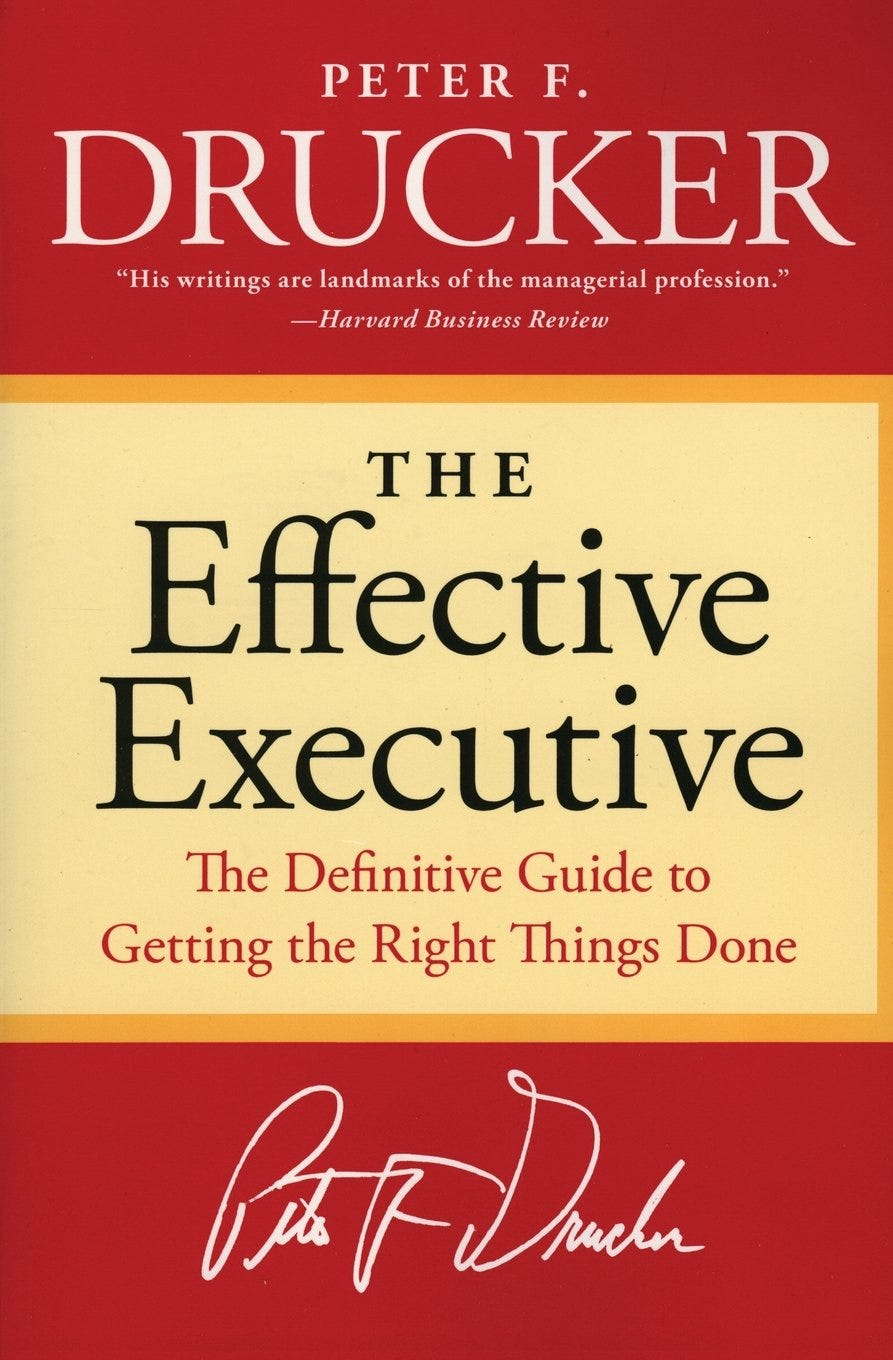
The Effective Executive
Marshall and Sloan cases are documented; the broader framework is consulting pattern-matching, not controlled research.
Five named practices — time log, contribution statement, posteriority list — are each deployable this week without setup.
Effectiveness as a discipline, not a gift — counterintuitive in 1966, still reorients the capable-vs.-productive gap.
Core Thesis
"Effective executives are made, not born — and what makes them effective is not intelligence or effort but five learnable practices, the most fundamental being the deliberate management of time as the one resource that cannot be replaced or recovered."
Verdict
- Must read for/if: Senior leaders, directors, and founders whose bottleneck is judgment rather than technical skill — people who are capable but not yet producing at the level their capability predicts. Also essential for any organization building a leadership development curriculum; this is the curriculum, not a supplement. If you manage knowledge workers and suspect that calendar chaos, weak decisions, or scattered priorities are compressing your output, this book names the mechanism and the fix.
- Skip if: You are an individual contributor with no meaningful control over your calendar, a team executing someone else’s priorities, or a manager in a heavily proceduralized environment where discretion is limited. Drucker writes for people who have enough autonomy to choose where their time goes. Without that autonomy, the practices have no surface to grip.
- Core business value: Effectiveness is the multiplier on intelligence and effort. Two executives with the same capability produce radically different results depending on whether they manage time deliberately, concentrate effort, staff for strengths, and make sound decisions. This book makes the difference explicit and teachable. The five practices convert raw capability into compounding output — and because they are practices, not traits, any executive can learn them.
- The reviewer’s take: The argument holds cleanly — effectiveness IS a discipline, not a personality type, and Drucker proves it through enough historically documented cases to make the claim durable across 60 years. The book’s single genuine weakness is that it almost entirely ignores the organizational conditions that make individual effectiveness impossible: a single effective executive inside a dysfunctional structure is still a failing organization. Drucker writes as if individual practice is sufficient; it is necessary, but not always sufficient.
Core Concepts
Drucker opens with a finding that should disturb any executive: the executives he studied who were considered effective were not notably different in intelligence, imagination, or knowledge from those who were not. What separated them was a set of five practiced habits. The book’s central claim — that effectiveness is a learnable discipline, not a talent — is both its thesis and its method.
The Five Practices of Effective Executives. Each practice addresses a distinct constraint on executive output. They are not a sequence; they are parallel disciplines that compound when all five are active simultaneously.
-
Know Thy Time — Before anything else, an effective executive records where their time actually goes — not where they think it goes. The practice begins with a written time log (not memory, which Drucker demonstrates is consistently inaccurate) over two weeks, identifies systematic time-wasters, and then consolidates discretionary time into large uninterrupted blocks. Knowledge work cannot be done in fragments: three hours of focused time totaling seven hours in 30-minute increments produces less than one solid three-hour block. The time log is the diagnostic; blocking is the intervention.
-
Ask What Can I Contribute? — The shift from “what do I need to do?” to “what results does the organization need from me?” is Drucker’s sharpest contribution. Most executives define their roles by inputs — reports, meetings, processes — rather than by the outputs those inputs are supposed to produce. The contribution question forces an outward orientation: toward the effect of the work on others, not toward the activity itself. It also makes performance observable and measurable: either the result appeared or it didn’t.
-
Make Strengths Productive — Effective executives staff positions for what a person can do, not to minimize what they cannot. As Drucker writes: “Whoever tries to place a man or staff an organization to avoid weakness will end up at best with mediocrity.” General Marshall, who built the U.S. Army’s officer corps in WWII, applied this directly — he promoted Eisenhower, Patton, and Bradley not because they were well-rounded but because each was exceptional at exactly what their command required. Marshall’s method: identify the one critical capability the role demands, evaluate on that dimension first, then check for a floor of competence elsewhere.
-
First Things First — Concentration is the executive’s only leverage over time. Drucker’s paired concept of “priorities” and “posteriorities” — explicit decisions about what NOT to do — is the most overlooked insight in the book. Deciding what to defer or abandon is harder than deciding what to pursue, and most executives never make the posteriority list explicit. The practice: work on one important thing at a time, for extended periods, until it is done. Drucker observed that effective executives concentrated on one major initiative per period — not because they had less to do, but because they understood that scattered effort produces no results.
-
Make Effective Decisions — Most decisions are not unique events. They are instances of a recurring category that should be handled by a rule or policy, not a case-by-case judgment. The executive’s job is to recognize which decisions are truly exceptional (requiring genuine judgment) and which are recurrent (requiring a permanent solution). For the genuinely exceptional: define what a satisfactory solution would look like, identify real alternatives, decide on principle rather than convenience, build in feedback to test whether the decision held. Drucker’s key diagnostic: “What would have to happen for this decision to be wrong?” is the practice most decision frameworks omit.
Case evidence and its limits. The Marshall case (strengths) and Sloan’s boardroom practice (decisions) are the two strongest examples in the book — both are historically documented and independently verifiable. Sloan’s practice of tabling unanimous board decisions for the next meeting — forcing the emergence of dissent before any consequential decision was finalized — is a direct demonstration of the “what would have to happen for this to be wrong?” principle. Where Drucker is on thinner ice is the contribution practice: the cases he cites (Theodore Vail at AT&T, Harry Truman) are plausible but selected to confirm the thesis. The counterfactual — executives who asked the contribution question and still failed — is never examined. The framework is sound; the evidentiary standard is that of a management consultant, not a social scientist.
Practical Applications
| Concept/Dysfunction | Organizational Symptom / Trigger | Leadership Intervention (The Play) |
|---|---|---|
| Fragmented Time | Leader is responsive and visibly busy but ships nothing significant; diary is a mosaic of 30-minute slots; team says “she’s always available” but can’t name what she delivered last quarter | Run a two-week time log — every 30-minute block recorded in writing, not from memory. Identify all recurring commitments that produce no result the leader would include in a performance review. Eliminate or delegate them. Block one 3-hour minimum for a single cognitive priority daily. Protect that block from all interruptions including self-imposed ones. |
| Activity Orientation | Team reports meeting hours, emails sent, and tasks completed as proxies for progress; leader cannot name what result their role produced last quarter | Replace weekly status updates with a “contribution board”: one column per person showing intended output (not tasks) for the period. At period-end, every output either exists or has an explicit reason it moved. Leader populates theirs first. The discipline is in making the commitment before the work begins, not explaining it after. |
| Weakness-Compensating Staffing | Team has no world-class capability; every hire is “solid across the board”; top performers are passed over for being “difficult” or “not a culture fit” | Before writing the job description, write one sentence: the single capability that would make this hire exceptional. Evaluate candidates on that dimension first — score it before reviewing anything else. Then check for a minimum floor of competence elsewhere. Hire the person who is dangerous at the critical capability, even if they need support around it. |
| Missing Posteriorities | Priority list grows every quarter; nothing is ever explicitly stopped; team is spread across a dozen initiatives; urgency is everywhere and importance is nowhere | At every planning cycle, enforce a one-in-one-out rule: for every new initiative approved, one existing initiative is explicitly stopped or deprioritized. Publish the stopped list. When someone proposes a new initiative, the first question is: “What are we stopping to make room for this?” Without a posteriority process, the priority list is aspirational, not operational. |
| Case-by-Case Decisions | Leader is consulted on every exception; the same problem category generates a fresh decision each time; junior managers don’t know where their decision authority begins and ends | Catalog the last 20 decisions by type. For every recurring category, draft a one-paragraph decision policy: “When X situation arises, the answer is Y, decided by Z.” Delegate all policy-covered decisions to the appropriate level immediately. Reserve executive judgment for the genuinely novel cases — if the decision fits a known pattern, it isn’t a judgment call, it’s a policy gap. |
Practical Tips
-
Run the two-week time log. For 14 consecutive working days, record in writing what you do in every 30-minute block — not what you planned, what actually happened. At the end, mark every block that contributed to a result you’d include in a performance review. Calculate the percentage. If less than 40% of your time maps directly to your stated priorities, your calendar and your intentions are not aligned. The gap is your effectiveness tax — schedule changes, not harder work, are the intervention.
-
Write your contribution statement before the quarter begins. One sentence: what result would prove that your role justified its cost this quarter? Write it before any planning is done, share it with your manager, and tape it somewhere visible. If after 30 days you cannot draw a direct line from your daily work to that statement, either the statement is wrong or the work is. Identify which before adding more effort.
-
Make the posteriority list explicit. At your next planning session, for every initiative you are adding or continuing, name one thing you are stopping or explicitly moving to later. Write the stopped list in the same document as the priority list. If after three months nothing has made it onto your stopped list, you do not have a priority process — you have an accumulation process. The absence of posteriorities is a leading indicator of scattered effort.
-
Test one decision type for the generic/exceptional split. Pick a category of problem you currently treat as unique each time it arises. Ask: has a version of this come up before? If yes, write the rule that should have handled it — one paragraph, the decision criteria and who makes it. Delegate future instances. If after six months the policy produces noticeably worse outcomes than your individual decisions did, you’ve confirmed that this category genuinely requires executive judgment. If the outcomes are similar, you’ve freed up the time you were spending on it.
-
Run the strengths audit on your next open role. Before the job description is written, write one sentence: the single capability that would make this hire exceptional in this role. Score the top three candidates on that dimension alone before reviewing anything else. If your final hire was not the top scorer on that dimension, investigate what overrode it — you’ve surfaced exactly where your staffing instincts diverge from the principle, and whether that divergence was deliberate or accidental.
Critical Analysis
The Effective Executive has aged better than almost any management book of its era because it describes practices, not theories: the five habits are directly observable, immediately testable, and independent of any particular organizational fashion. The argument holds — effectiveness is a discipline, not a gift — and the 60 years since publication have produced no credible counterevidence to the central claim. What has changed is the context in which the practices operate, and in most cases the changes make Drucker’s practices more important, not less.
Modern conditions:
-
Remote and async work — STRONGER. Drucker’s critique of activity orientation becomes more urgent when activity is invisible and output is the only thing that can be verified. The contribution question — “what results is the organization expecting from me?” — is exactly what managers of distributed teams consistently fail to ask, and the failure produces the same pathology Drucker named: meetings, reports, and responsiveness mistaken for productivity. The time log practice, applied to Slack response time and calendar attendance, would reveal uncomfortable truths in most remote organizations.
-
AI tools augmenting knowledge work — STRONGER. As AI handles more drafting, summarizing, and routine analysis, what remains for executives is precisely what Drucker focused on: decision quality, judgment about where to concentrate effort, and contribution orientation. The practices that made executives effective in 1966 describe what humans will need to be effective in a world where execution is increasingly automated. Drucker essentially described the uniquely human layer of knowledge work 60 years before AI made that layer the only irreplaceable one.
-
Notification culture and fractured attention — STRONGER. Drucker observed in 1966 that executives systematically underestimated how fragmented their time was. Today the fragmentation is structural and amplified by the tools themselves. His diagnosis of fragmented time as the root cause of ineffectiveness is more accurate now than when he wrote it — and his practices (time log, blocking, posteriorities) remain the only tools that address root cause rather than symptoms.
Framework gaps:
- The book is silent on organizational conditions. Five effective executives inside a dysfunctional structure don’t produce an effective organization — they produce five islands of personal productivity in an ocean of organizational entropy. Drucker writes as if individual practice is sufficient; for most readers, the binding constraint is not their own habits but the system they operate inside. The book gives no guidance on how to change that system.
- The decision framework predates behavioral economics. Drucker’s decision process is excellent as a logical structure but doesn’t engage with the cognitive biases that make it hard to follow in practice — confirmation bias in problem definition, loss aversion in setting posteriorities, status quo bias in identifying alternatives. Kahneman’s work didn’t exist in 1966, but readers applying Drucker’s framework today should pair it with Thinking, Fast and Slow to understand the mechanism of failure the framework doesn’t address.
Competing frameworks Drucker doesn’t engage:
- Getting Things Done (David Allen) addresses the capture and processing problem Drucker ignores entirely. The first practice — know thy time — assumes you know what’s on your plate. Most executives don’t. GTD provides the input-processing system that Drucker’s practices assume is already solved. By ignoring this, Drucker leaves readers with the prioritization framework but not the infrastructure to feed it.
- Essentialism (Greg McKeown) reframes Drucker’s concentration practice as a complete operating philosophy, and adds what Drucker omits: the social and psychological barriers to saying no. McKeown’s “graceful no” practices and decision criteria for what qualifies as essential are direct practical extensions of Drucker’s fourth habit. Essentialism is the implementation manual for the prioritization practice Drucker describes but doesn’t teach.
Sources: Nat Eliason · Shortform · Thinkers50
Quotes
“If there is any one 'secret' of effectiveness, it is concentration. Effective executives do first things first and they do one thing at a time.”
“Whoever tries to place a man or staff an organization to avoid weakness will end up at best with mediocrity.”
“The reason why so few executives concentrate is the difficulty of setting 'posteriorities' — that is, deciding what tasks not to tackle — and of sticking to the decision.”
“Effectiveness is a habit; that is, a complex of practices.”