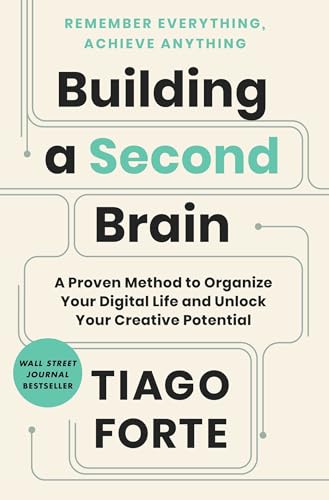
Building a Second Brain
The framework draws on 50,000+ self-selected course students with no controlled comparison against alternative PKM systems.
PARA, Progressive Summarization, Project Dashboard are specific enough to implement in under an hour without guidance.
Organizing by actionability rather than topic solves why note systems fail at retrieval — a structural inversion.
Core Thesis
"Your mind is for having ideas, not holding them. By externalizing knowledge into a trusted digital system using the CODE method (Capture, Organize, Distill, Express) and the PARA organizational framework, you free cognitive resources for creative work and ensure no valuable insight is lost."
Verdict
- Must read for/if: Knowledge workers drowning in information — bookmarks never revisited, notes scattered across five apps, ideas lost because they were never captured. Also essential for anyone managing complex projects across multiple domains who needs a reliable external memory system.
- Skip if: You already have a functioning PKM system (Zettelkasten, GTD, or equivalent) you actively use. Less useful if your work is primarily physical or procedural rather than knowledge-intensive.
- Core business value: Eliminates the “I read that somewhere” problem. Converts passive information consumption into reusable creative assets. The PARA system alone recovers hours per week in context-switching costs by organizing knowledge around active projects rather than arbitrary topic categories.
- The reviewer’s take: The CODE method and PARA framework are genuinely deployable — Forte synthesizes GTD and Zettelkasten into a practical digital-age system that 50,000+ course students have road-tested — but the book is light on evidence, heavy on personal testimony, and the framework’s real test is whether users maintain it past week three, a problem the book acknowledges but doesn’t fully solve.
Core Concepts
Your mind is optimized for synthesis and pattern recognition, not storage and retrieval. The mechanism: externalizing knowledge into a trusted system frees working memory for the thinking that produces value. Forte’s CODE method operationalizes this in four stages:
- Capture — get information out of your head and into the system. The test: does this resonate? If yes, save it. Don’t filter aggressively at this stage.
- Organize — place it where you’ll use it, not where it was created. File by actionability, not by topic.
- Distill — progressively summarize to extract the essential 10% of the 10%. Each time you revisit a note, bold the key sentences; next pass, highlight the bolded text. Notes you never revisit naturally become less prominent.
- Express — turn personal knowledge into outputs that serve others. The value of a second brain is measured by what comes out, not what goes in.
The PARA framework provides the organizational scaffold: Projects (active work with deadlines), Areas (ongoing responsibilities without endpoints), Resources (reference material for future use), Archive (inactive items). Most people organize by topic — Marketing, Research, Strategy — and find nothing when a project starts. PARA organizes by how you actually work.
Example: A product manager reads 20 articles on user retention, listens to a podcast on habit formation, attends a conference talk on behavioral psychology. Instead of filing these across scattered topic folders, each note goes into the active Project folder “Retention Redesign Q2.” When the project kicks off, the material is already organized. When it ends, the folder moves to Archive with a distilled “Lessons” file for future reference — ready to resurface when the next retention project starts.
Evidence Quality: Based on Forte’s consulting practice and online course (50,000+ students). Strong practitioner validation. No controlled studies, no peer-reviewed research. The framework’s theoretical grounding borrows from cognitive science (extended mind thesis, David Allen’s GTD) without engaging the primary literature directly. It works because it’s practical and low-friction — not because Forte has proven it outperforms alternatives.
Practical Applications
| Concept/Dysfunction | Organizational Symptom / Trigger | Leadership Intervention (The Play) |
|---|---|---|
| Capture Failure | Team attends meetings, reads reports, retains nothing actionable; same questions resurface weekly | End every meeting with a 3-bullet summary filed in the shared project folder. For every article or report worth reading, require a 2-sentence note in the team wiki. Make capturing a team norm, not an individual habit. |
| Organization by Topic (Not Project) | Knowledge scattered across “Marketing,” “Strategy,” “Research” folders; when a project kicks off, team spends days hunting for relevant material | Adopt PARA for team knowledge: reorganize into Projects (active), Areas (ongoing), Resources (reference), Archive (inactive). Every document lives where it will be used, not where it was created. Run the initial setup in a 2-hour team session. |
| Passive Consumption | Team reads extensively, attends conferences, takes courses — but produces nothing from it; “learning culture” without output | Require the Express step: every course, conference, or book generates one deliverable — a team presentation, a decision framework, a written recommendation. Consumption without expression is entertainment. |
| Note Hoarding | Individual contributor has 10,000 notes but can’t find anything; system is write-only | Implement Progressive Summarization: the next time you revisit any note, bold the key sentences. Next pass, highlight the bolded text. Each pass distills the note further. Notes you never revisit stay in Archive and stop demanding attention. |
| Context-Switching Tax | Knowledge workers lose 20+ minutes rebuilding mental context when switching between projects | Create a Project Dashboard for each active project: current status, next actions, key resources, open questions — all on one page. When you switch projects, the dashboard rebuilds context in 2 minutes instead of 20. |
Practical Tips
-
Set up PARA in 15 minutes: Open your current note-taking tool and create four top-level folders: Projects, Areas, Resources, Archive. Move your three most active projects into Projects. Drop everything else into Archive. Don’t organize further — the structure will reveal itself as you work. Perfecting the system before using it is procrastination.
-
Start the capture habit: For every meeting, article, or conversation today, write one sentence: “The key insight is [X].” File it in the relevant Project folder. Capture the spark, not the fire. The constraint is intentional — if you can’t summarize it in one sentence, you haven’t understood it yet.
-
Run Progressive Summarization on one existing note: Find one document you’ve saved but never re-read. Read it, bold the 10% that matters. Then highlight the 10% of the bolded text that’s truly essential. You now have a note you can scan in 15 seconds. That’s the entire technique.
-
Create one Project Dashboard: Pick your most active project. Build a single page: current status, next actions, key resources, open questions. Use it as your re-entry point the next time you context-switch into this project. Measure how much faster orientation takes.
-
Express one insight: Take one captured insight from this week and turn it into something shareable — a Slack message to your team, a one-paragraph recommendation, a decision framework. The output is the proof of concept. If nothing has come out of your system this week, the system isn’t working yet.
Critical Analysis
Building a Second Brain solves a real problem — the cognitive overhead of managing information at scale — and provides a framework practical enough that a large practitioner community has validated it; the limitation is that Forte’s own course graduates are the evidence base, the maintenance problem is undersolved, and AI-powered retrieval has already automated the most labor-intensive steps the book was written to address.
Modern Conditions:
-
AI as knowledge retrieval layer — WEAKER/EVOLVED. When Forte wrote the book, manual curation was the only option. AI-powered search (Notion AI, Obsidian Copilot, RAG-based systems) now lets you query notes in natural language without tagging, organizing, or distilling first. The Capture and Organize steps are less labor-intensive than the book implies. The Distill and Express steps — requiring human synthesis and judgment — remain irreplaceable and are now the highest-leverage activities in the framework.
-
Information overload acceleration — STRONGER. The volume of information knowledge workers encounter has increased sharply since 2022. Without a system, the default is chaos. AI generates more content to process, not less. Forte’s framework provides scaffolding; specific tools matter less than the discipline of externalizing and processing systematically.
-
Remote and async work — STRONGER. Distributed teams depend on written artifacts. A PKM system that produces shareable, distilled outputs — not raw notes — becomes a team asset, not just a personal one. The Express step is the highest-leverage component for remote workers precisely because organizational memory doesn’t exist unless someone writes it down.
Framework Gaps:
- The book underweights maintenance. Any PKM system accumulates cruft. Without rigorous review cycles, the second brain becomes a junk drawer within months. Forte mentions archiving but doesn’t provide the structured review protocols that keep the system functional long-term.
- Tool-agnostic in theory, but assumes personal note-taking apps (Notion, Evernote, Obsidian). No guidance on integrating with enterprise systems — Confluence, SharePoint, Google Drive — where most organizational knowledge already lives. For teams, the system requires adoption infrastructure the book doesn’t address.
Competing Frameworks:
- Niklas Luhmann’s Zettelkasten is the more rigorous alternative for research and writing — atomic notes linked by ideas rather than categories. Forte’s PARA is more practical for project management; Zettelkasten produces better long-term synthesis. By not engaging Luhmann seriously, Forte leaves readers without guidance on when to choose one approach over the other.
- Sönke Ahrens’ How to Take Smart Notes goes deeper on note-linking and the permanent note concept that Forte treats lightly. Ahrens engages the Zettelkasten method more rigorously; for anyone whose work involves sustained research or writing, Ahrens is the superior complement.
- David Allen’s Getting Things Done focuses on task management rather than knowledge management. Forte’s PARA explicitly complements GTD — but by not integrating the two systems, the book leaves a gap for readers who need both. The interaction between project-based knowledge organization and task execution is exactly where practitioners get stuck.
Quotes
“Your mind is for having ideas, not holding them.”
“Knowledge is only valuable if you can find it when you need it and use it to create something new.”