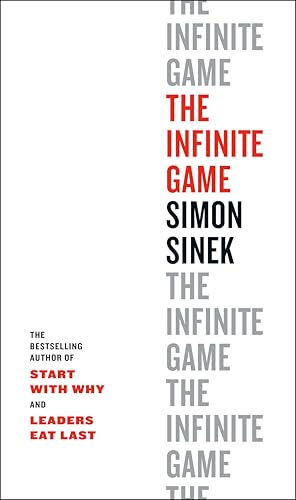
The Infinite Game
Claims rest on reused vignettes — Microsoft/Apple, CVS, Victorinox. No data shows infinite-minded firms outperform.
Each practice has a named exercise — Just Cause test, Worthy Rival memo, candor round — but no sequencing rules.
Finite/infinite distinction is Carse's 1986 philosophy, lightly adapted. Carse or Collins readers will find nothing new.
Core Thesis
"Most CEOs play to win a game that has no finish line, and that mismatch — finite tactics inside an infinite competitive arena — is what produces brittle companies, eroded trust, and burned-out workforces."
Verdict
- Must read for/if: You are a founder or operating executive whose quarterly cadence has eaten your long-horizon thinking — earnings calls, OKR cycles, and competitor takedowns now define strategy. The five practices give you a vocabulary for pushing back against short-termism in board meetings without sounding naive.
- Skip if: You want rigorous evidence or original frameworks. Sinek borrows James Carse’s finite/infinite distinction from a 1986 philosophy book and applies it loosely; if you have read Carse, Good to Great, or Built to Last, two-thirds of this book will feel familiar. Also skip if you need operational depth on the practices themselves — each gets one chapter and a handful of examples.
- Core business value: Reframes the question executives ask in strategy meetings from “How do we beat them this year?” to “How do we still be playing in twenty years?” The reframe is the entire ROI. Specific tools for the reframe are thin.
- The reviewer’s take: The central distinction is correct and useful — most public-company leadership genuinely confuses winning a quarter with running a business — but Sinek’s evidence is cherry-picked, his “Just Cause” criteria collapse under scrutiny, and the book’s best chapter (Trusting Teams) recycles psychological-safety research that Amy Edmondson already laid out with more rigor.
Core Concepts
Sinek borrows from philosopher James Carse, who in Finite and Infinite Games (1986) divided human activity into two game types. Finite games have known players, fixed rules, and an agreed objective — football, chess, election cycles. Infinite games have known and unknown players, changing rules, and no defined end — the goal is to keep playing. Business, Sinek argues, is infinite. There is no “winning” capitalism. Yet most executives behave as if they are coaching a Super Bowl team: optimize for the next quarter, defeat the named competitor, declare victory at IPO.
The dysfunction follows mechanically. A finite player inside an infinite game eventually exhausts their resources — talent, trust, capital reserves, customer goodwill — because each is treated as a means to a finish line that does not exist. Sinek’s recurring case study is Microsoft under Ballmer (finite mindset: “beat Apple”) versus Microsoft under Nadella (infinite mindset: “empower every person and organization on the planet to achieve more”). The stock price reversal under Nadella is presented as proof, though Sinek does not engage with the obvious confounding variables — cloud migration timing, Azure’s enterprise contracts, Office 365 subscription conversion. The frame is suggestive, not causal.
The five practices that constitute an “infinite mindset”:
- Just Cause — a specific, affirmative vision of a future state that does not yet exist, is for something rather than against something, is service-oriented (benefits others, not the organization), inclusive (open to anyone willing to contribute), resilient (survives changes in technology and leadership), and idealistic (impossible to fully achieve). Sinek’s criteria are restrictive enough that most actual mission statements fail his test, including, by his own admission, his publisher’s.
- Trusting Teams — environments where people feel safe to admit mistakes, ask for help, and surface bad news without retribution. This is psychological safety, repackaged. Sinek’s Castle Rock submarine vignette and Four Seasons hotel anecdote are the book’s strongest concrete passages.
- Worthy Rivals — competitors selected for what they reveal about your weaknesses, not for elimination. Adam Grant is Sinek’s named worthy rival. The practice is essentially intellectual humility with a business label.
- Existential Flexibility — willingness to make a strategic pivot so disruptive it threatens the current business, in service of the Just Cause. Walt Disney mortgaging his house to fund Disneyland is the canonical example. Critics rightly note that the survivorship bias here is severe: for every Disney there are a hundred unnamed founders who bet the company on a pivot and died.
- Courage to Lead — willingness to deviate from finite-game incentives (quarterly earnings, peer-comparison metrics) when the Just Cause demands it. CVS dropping cigarettes (a $2 billion revenue hit) is the centerpiece example.
Evidence Quality: Anecdote-driven, not data-driven. Sinek cites no peer-reviewed studies for the five practices as a system. The Microsoft/Apple comparison, CVS cigarettes story, and Victorinox-after-9/11 case are reused across multiple chapters. There is no longitudinal data establishing that “infinite-minded” companies outperform “finite-minded” companies on any measurable axis — Sinek instead asserts the connection and selects supporting examples. The Strategy Bridge review and Yevgeniy Brikman’s analysis both flag the same pattern: cherry-picked vignettes wrapped in confident assertions. Where Sinek is on thin ice: the claim that finite-minded leaders cause Wells Fargo-style scandals (his read of the 2016 fake-accounts crisis as a finite-game failure ignores documented governance and incentive-design literature); the framing of the Cold War as an “infinite game” Reagan won by changing his mindset (a contested historical reading — actual Cold War strategy literature does not support it); the Just Cause criteria, which Sinek presents as objective tests but applies inconsistently.
Practical Applications
| Concept/Dysfunction | Organizational Symptom / Trigger | Leadership Intervention (The Play) |
|---|---|---|
| Finite Mindset in Infinite Arena | Strategy meetings center on “beating” a named competitor; OKRs cascade from quarterly revenue targets only; leadership turnover spikes after missed quarters | Open the next strategy offsite with: “If we vanished tomorrow, what would the world lose?” Spend the first 90 minutes there. Do not allow competitor mention until after lunch. Document the answer as the Just Cause draft; revisit quarterly, not annually. |
| Just Cause Vacuum | Mission statement is generic (“best-in-class,” “leading provider”); employees cannot articulate the company’s purpose without reading the wall; recruiting pitch leads with comp and perks | Stress-test your stated cause against Sinek’s five criteria: For something? Inclusive? Service-oriented? Resilient to leadership change? Idealistic (impossible to finish)? If any fail, rewrite. Have ten frontline employees describe the cause in their own words; if you get ten different answers, the cause is not yet real. |
| Low Trust on Teams | Bad news arrives late or filtered; “we’ll figure it out” replaces specifics in status updates; high performers leave with vague explanations; meetings end with no one saying what they actually think | Run a “What I’m not telling you” round at next leadership offsite. Each person names one thing they have been holding back. Leader goes first, names a real one, and absorbs the response without defending. Repeat quarterly. Measure: number of pre-emptive escalations of bad news in the following 90 days. |
| Competitor Obsession | Sales decks lead with feature comparisons; product roadmap is reactive to competitor releases; team morale dips when competitor wins a deal | Pick one Worthy Rival explicitly. Write a one-page memo: “What [Rival] does better than us, and what that reveals about our gap.” Circulate to the executive team. Repeat with a different rival every six months. The frame is study, not defeat. |
| Strategic Inflexibility | Leadership defends the current business model in the face of clear shifts; new bets are sub-scaled to protect P&L; “we tried that in 2019” closes conversations | Run a pre-mortem on the current business: “Assume we will be irrelevant in ten years. What killed us?” Then ask: “What disruption to our current model — that we could initiate today — would prevent that?” Fund one experiment that threatens current revenue. Track its progress separately from core P&L. |
| Finite Incentive Capture | Compensation, board pressure, or analyst expectations force quarterly behavior that conflicts with stated long-term direction; leadership privately disagrees with public guidance | Identify one decision in the past year where you made the finite choice (cut R&D, delayed hire, pulled investment) under quarterly pressure. Name it in writing. Ask the board: “What would have to be true for us to make the opposite call next time?” That conversation is the work. |
Practical Tips
- Run the Just Cause stress test on your own mission statement this week. Pull your company’s published mission. Score it against Sinek’s five criteria (for something / inclusive / service-oriented / resilient / idealistic). What you will notice: most corporate missions fail at least three. If yours does, the cause is decoration, not direction.
- Replace one competitor slide with a Worthy Rival memo. In your next board or all-hands deck, remove the feature-comparison chart. Replace it with a one-page memo titled “What [Competitor] does better than us.” Read the room. What you will learn: how much of your strategic identity is built on opposition to others versus pursuit of something.
- Stage a “what I’m not telling you” round. At your next leadership team meeting, go first. Name one piece of information you have been holding back. Do not editorialize, do not apologize. Wait. The question is whether anyone else goes. If no one does, you do not have a trusting team; you have a polite one.
- Fund one experiment that threatens your core P&L. Identify one initiative the current business would rationally kill (cannibalizes margin, threatens a major customer segment, requires writing down existing assets). Allocate it 5% of headcount and protect it from quarterly review for four quarters. What you will observe: whether your operating system can tolerate Existential Flexibility, or whether it strangles the experiment by month three.
- Audit one finite decision you made under quarterly pressure. Pick a decision from the past twelve months you would not have made on a five-year horizon. Write down what made you make it anyway. Take that document to your next board meeting. The conversation that follows reveals whether your governance is structured for an infinite game or a finite one.
Critical Analysis
The central distinction is correct and the book’s diagnosis of quarterly capitalism is sharper than its prescriptions. Sinek is right that executives systematically confuse winning rounds with winning the game, and the five practices are a useful checklist for diagnosing where a leadership team has slipped into finite thinking. The book breaks down on three fronts: the evidence base is thin and selectively assembled, the philosophical borrowing from Carse is partial and at points mistaken, and the practices are described in a way that resists falsification — every successful long-lived company can be retrofitted into an “infinite mindset” narrative, which means the framework cannot actually be tested against companies that failed despite holding the same posture.
2024+ realities:
- AI-driven product cycles (WEAKER): Sinek’s argument that great companies optimize for decades, not quarters, runs into the reality that competitive moats now compress on six-to-eighteen-month AI capability cycles. OpenAI’s release cadence has forced Microsoft, Google, and Anthropic into reactive postures that look finite-minded but are existential. The “infinite mindset” cannot tell a leader when reactive speed is correct and when it is finite-game capture; the book offers no decision rule.
- Remote-first and distributed teams (NEUTRAL): Trusting Teams chapter holds up — psychological safety is more, not less, important in distributed work, where signals are lower-bandwidth. But Sinek’s examples (submarine crew, Four Seasons housekeepers) are all co-located physical-presence cases. The practice transfers; the playbook does not.
- Activist investors and short-seller pressure (WEAKER): The “Courage to Lead” prescription — defy quarterly incentives in service of the Just Cause — sits awkwardly against the modern reality of activist campaigns that can replace boards within a single proxy season. Sinek’s CVS example happened under a CEO with strong board backing and no activist on the cap table; he does not address what infinite-minded leadership looks like when Elliott or Pershing Square shows up.
Gaps in the framework:
- No diagnostic for when the Just Cause is wrong. Sinek treats Just Cause selection as an act of discovery, not analysis. He gives no test for distinguishing a genuine cause from a self-flattering rationalization. Theranos had a Just Cause by his criteria.
- No theory of organizational decay. Companies that started infinite-minded (Sinek would name Disney, Patagonia) drift toward finite behavior over time. The book does not explain the mechanism or how to prevent it.
Competing frameworks Sinek ignores:
The most glaring omission is Amy Edmondson’s The Fearless Organization (2018), which gives the Trusting Teams chapter its empirical foundation but receives no citation. Edmondson did the actual research on psychological safety across hundreds of teams; Sinek summarizes the concept and adds anecdotes. By not engaging her work, he leaves readers without the measurement tools (the 7-item psychological safety scale, the candor-vulnerability mapping) that would make the practice actionable. Similarly, Jim Collins’s Good to Great and Built to Last — which spent twenty years arguing that long-horizon, mission-centered companies outperform — get a brief mention but no engagement. Collins built his case on a controlled comparison of 1,435 companies; Sinek builds his on roughly two dozen anecdotes. Engaging Collins directly would have forced Sinek to either inherit the methodological rigor or explain why his framework adds something Collins missed. He does neither. Finally, the book never engages Clayton Christensen’s disruption work, which is the closest existing theory to Sinek’s “Existential Flexibility” — and which would have given the practice an actual mechanism instead of Disney anecdotes.
Note: This is Phase 1 (research-based executive briefing). The /enrich-book skill will validate all claims against the PDF and deepen critical analysis if needed.
Quotes
“There are at least two kinds of games: finite games and infinite games. A finite game is played for the purpose of winning, an infinite game for the purpose of continuing the play.”
“When we lead with a finite mindset in an infinite game, it leads to all kinds of problems, the most common of which include the decline of trust, cooperation and innovation.”
“A Just Cause is a specific vision of a future state that does not yet exist; a future state so appealing that people are willing to make sacrifices in order to help advance toward that vision.”
“When you study a Worthy Rival, your focus is on improving. When you compare yourself to a competitor, the focus shifts to winning.”